
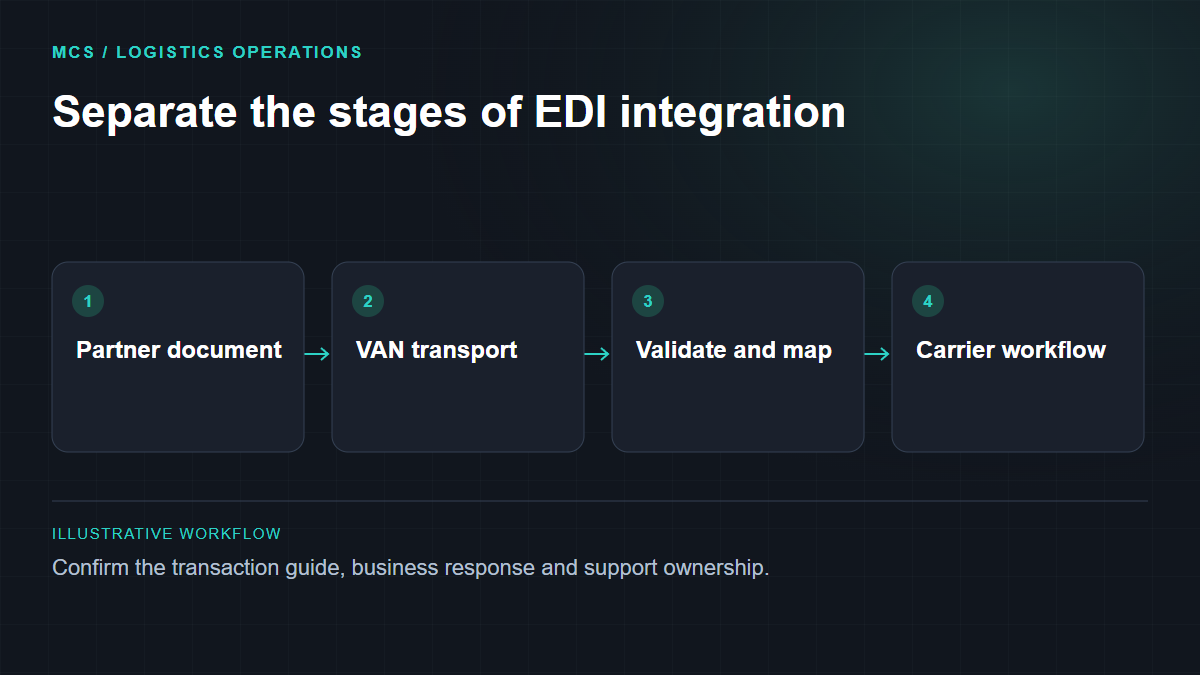
Receiving an EDI document is not the same as creating usable operational work. If your team still checks references or re-enters received data, clarify the document's purpose, the trading partner's fields and the handoff into your carrier system before automating the flow.
Confirm the document before designing the mapping
Ask which business event the partner is communicating and which transaction version and implementation guide apply. Do not assume that every retailer order, pickup or manifest should be represented by EDI 204. X12’s stated purpose specifically distinguishes the 204 from certain less-than-truckload bill-of-lading, pickup and manifest uses.
Confirm the expected response and acknowledgement process with the trading partner. A transport receipt, an EDI acknowledgement and business acceptance are different stages and should be tracked separately.
Separate VAN transport from business processing
Where an OpenText VAN connection is part of the agreed environment, identify its role in exchanging documents between trading partners. The messaging route is one part of the workflow. The received document still needs validation, partner-specific mapping and a controlled handoff to the carrier’s operational system.
Define who owns the partner identifiers, connectivity setup, message tracking and support escalation. Do not treat the use of a named VAN as proof of guaranteed business acceptance, complete data accuracy or automatic regulatory compliance.
Map the partner’s fields to operational requirements
Review scheduling details, locations, references and other fields required for the specific tender and receiving workflow. Preserve the partner’s identifiers alongside the carrier’s internal references so later changes and responses can be linked correctly.
Validate the information needed by the destination before creating operational work. A document can be structurally readable while still missing a field the carrier requires. Route those conditions to a clear review process rather than silently filling gaps with assumptions.
Plan updates, duplicates and exceptions
Agree how changed or repeated messages are recognized, how cancellations are treated and which requests require a person’s decision. Store enough context to understand what was received, which mapping was used and what the destination accepted or rejected.
If the TMS is unavailable or rejects a record, distinguish a safe retry from a request that needs correction. An automated retry should not create duplicate jobs or conceal an unresolved business exception.
Test the end-to-end relationship
Use partner-approved sample messages and representative operational cases. Check the transport stage, validation, mapped data, destination result and expected return message. Include invalid references, repeated submissions and a failed downstream handoff.
MCS can scope retailer connectivity, TrackOps and TMS integration around those requirements. The useful deliverable is a documented and tested data relationship with support ownership, not a generic claim that EDI eliminates every error or connects every retailer in the same way.
Separate a delivered document from an accepted tender
Illustrative workflow: a document reaches the agreed VAN route, but the carrier's receiving workflow cannot match a required location reference. The transport stage is recorded, while the business record remains in review with the missing mapping identified.
After the reference is resolved, the workflow validates the mapped record and checks the destination result. The agreed acknowledgement or response process follows the trading partner's guide. This keeps message delivery from being mistaken for operational acceptance.
What to measure
Measure documents awaiting mapping, missing destination fields, repeated submissions and unresolved downstream failures. Keep transport acknowledgements distinct from business acceptance when reporting progress.
Before committing to an EDI 204 scope
- Confirm that EDI 204 is the appropriate transaction for the business event.
- Obtain the partner’s version, guide, identifiers and test requirements.
- Separate document transport from business acceptance.
- Map validation errors and downstream failures to named owners.
- Test updates, duplicates and return messages end to end.
Common questions
Is EDI 204 a general retail purchase order?
No. X12 defines it as a Motor Carrier Load Tender. The correct document for a particular retailer workflow must be confirmed against the business event and trading partner requirements.
Does a VAN remove the need for validation?
No. Transport and message tracking do not replace partner-specific field validation, business rules or acceptance testing in the destination system.
Plan your next step
Bring the partner's implementation guide and an anonymized sample message. MCS can help define the document scope, mapping dependencies and end-to-end acceptance tests.
Related guides and services
- Explore order integration services
- Explore retailer and TMS integration
- Plan two-way TMS messages and exceptions