
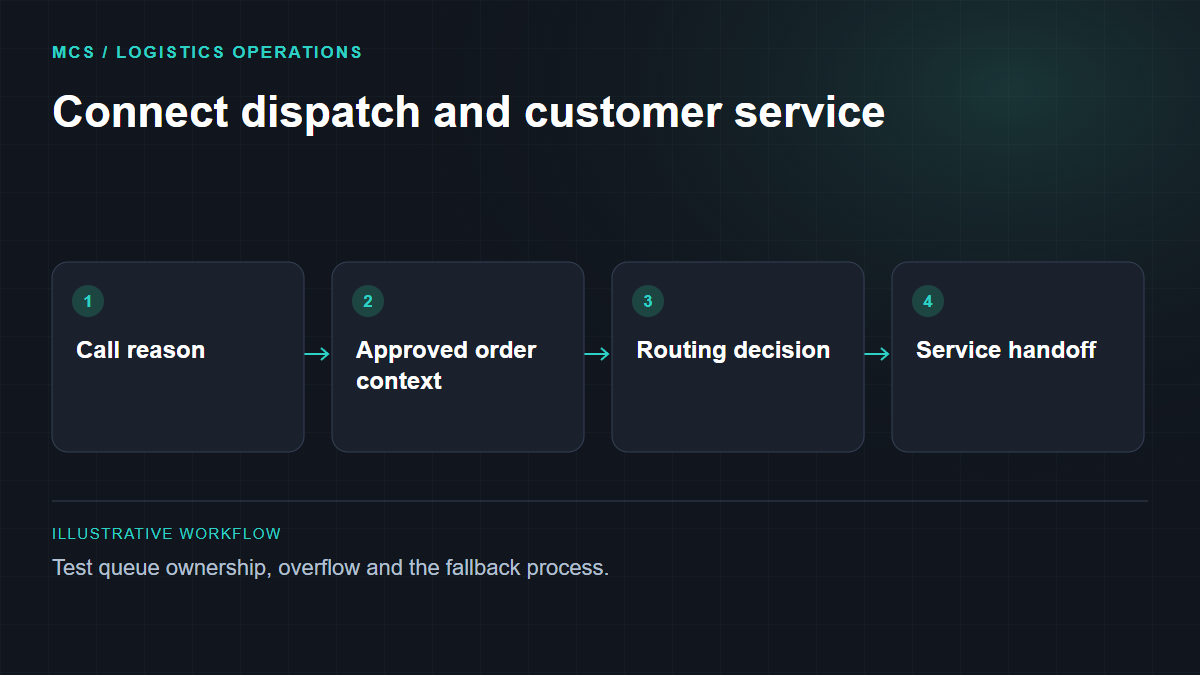
A customer should not have to explain the same delivery problem at every transfer. For dispatch and customer service, the useful starting point is a phone workflow that connects call reasons, order context and decision ownership across teams and locations.
Map the calls that matter to the operation
Identify who calls, why they call and which team can make the relevant decision. Separate delivery-status questions, rescheduling requests, warehouse coordination, retailer enquiries and internal escalation. A single queue can create unnecessary transfers when responsibilities are unclear.
Consider location, business hours and time-zone differences across Canadian and US operations. Define what the caller should hear and where the call should go when the appropriate team is unavailable.
Put useful order context within reach
Customer service needs a reliable way to find the relevant order and approved delivery information. That may involve a defined lookup process or a scoped connection to operational tools. Do not assume that a caller’s number uniquely identifies an order or proves the caller’s identity.
If a system integration is proposed, clarify which data can be accessed, how the match is reviewed and what is shown to the staff member. Limit the information to what the role needs for the supported task.
Define routing and escalation ownership
Document queue membership, overflow rules, transfer responsibilities and the route for an urgent operational issue. Staff should know when to keep a case, when to escalate and what information needs to accompany the handoff.
Test the ordinary failure cases: an unanswered call, a full queue, a wrong transfer and a disconnected location. The customer experience depends on how the workflow handles those cases, not only on the welcome message.
Review connectivity, devices and information handling
Voice services rely on the relevant network, endpoints and provider arrangements. Assess connectivity, device configuration and the fallback process for a local outage. Confirm the responsibilities of your IT and phone providers rather than leaving an ownership gap.
Where recordings or call records are used, establish appropriate access, retention and review responsibilities. Requirements depend on the use case and jurisdictions involved; do not treat the availability of a recording feature as automatic permission to use it in every situation.
Measure the handoff instead of promising an outcome
Choose measures such as repeated transfers, calls without a resolved owner, queue abandonment and the effort needed to find an order. Define the reporting period and what each measure represents before comparing results.
MCS can scope business communications as part of logistics-focused managed IT. The goal is a phone workflow that fits the people, systems and escalation arrangements in your operation—not a claim that a new phone system alone will reduce calls or improve satisfaction by a fixed amount.
Route a delivery question to the right owner
Illustrative workflow: a customer asks to change a delivery arrangement. Customer service locates the relevant order through the approved lookup process and identifies whether the request needs dispatch review.
If a transfer is needed, the receiving team gets the order reference and request context through the agreed handoff. The phone workflow also defines what happens when that team is unavailable, so the request keeps a visible owner and next action.
What to measure
Track repeated transfers, calls without an assigned owner, abandonment and the effort needed to find order context. Use those measures to review the workflow before attributing a customer-experience improvement to a new phone system.
VoIP discovery questions for delivery teams
- Which team owns each common call reason?
- What happens after hours or across time zones?
- How will staff locate and verify the relevant order?
- Who maintains queues, devices and escalation rules?
- What is the fallback plan for network or provider issues?
Common questions
Does VoIP automatically connect to our TMS?
No. Any connection depends on the phone platform, TMS interfaces, permissions and the workflow to be supported. Confirm the scope before assuming integration.
Can the phone system replace customer verification?
No. Caller information may help locate a record, but your operation still needs an appropriate process for verifying identity and deciding what information can be disclosed.
Plan your next step
Bring your most common call reasons and one difficult transfer. MCS can help map the routing, order context and IT responsibilities needed for a clearer service handoff.