
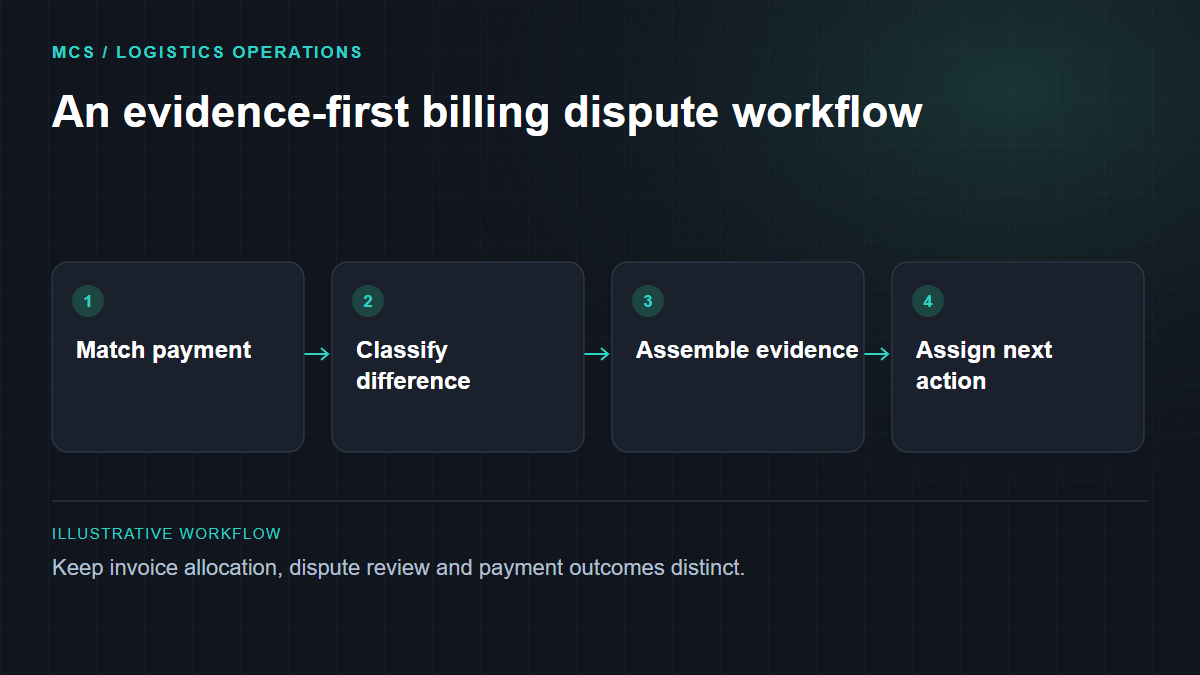
An unresolved payment difference is difficult to work when nobody can see the invoice, delivery evidence and next action together. Give finance a clear process for matching payments, classifying differences and preparing an order-level explanation before following up.
Start with an invoice that can be traced
Keep the relationship between the retailer reference, carrier order, invoice and service line. Record the rate version and the evidence needed for the charge. If several services belong to one stop, make their treatment explicit rather than relying on a single completion status.
Before submission, check for duplicates, missing references and records awaiting operational review. A finance team can handle an identified exception more effectively than an unexplained rejection discovered after the invoice has been sent.
Separate payment matching from dispute decisions
A remittance can cover several invoices, include deductions or arrive without enough detail to match immediately. Identify what can be allocated confidently and what remains unapplied. Do not automatically classify every difference as a valid dispute or a recoverable balance.
Define the categories your team uses, such as missing payment detail, rate disagreement, missing evidence, duplicate charge or timing difference. Different categories require different investigation and escalation paths.
Build a reviewable evidence bundle
For each variance, bring together the relevant invoice line, applicable rule, delivery event, service confirmation and correspondence. Use only the records needed for the issue and control access to customer-sensitive information.
The bundle should explain the question being raised, not simply contain a large collection of attachments. A clear order-level reference and a concise account of the variance can make review more productive for both teams.
Give follow-up a defined owner
Assign responsibility for researching the discrepancy, requesting missing information, submitting a response and recording the result. Keep the next action and relevant deadline visible. Without those details, a shared spreadsheet can become a list of unresolved balances rather than a working process.
Record why an item was accepted, adjusted, escalated or closed. That history helps the team distinguish a one-off issue from a recurring source-data or rule problem.
Improve the upstream process from recurring disputes
Review the reasons behind repeated corrections. If the same service evidence is missing, the operational capture process may need attention. If a rate is repeatedly disputed, confirm the source agreement and mapping. If references cannot be matched, address the identifiers at invoice generation.
Measure dispute age, repeat reasons, unresolved payment differences and the effort needed to assemble evidence. Recovery amounts and resolution times depend on the actual agreements and cases; they should not be promised as universal results.
Separate a short payment from an evidence dispute
Illustrative workflow: a remittance covers several invoices but does not identify the reason for one deduction. Finance first checks the references and allocation. The unmatched difference remains a payment-review item until the reason is established.
If the partner later questions a service line, the owner assembles the relevant rule, service confirmation and correspondence. The case history records the next action and the eventual decision, keeping payment allocation and dispute resolution understandable as separate steps.
What to measure
Track unmatched payment age, dispute age, repeat reasons and the time spent assembling evidence. Report submitted, adjusted, resolved and paid items distinctly; a follow-up submission is not the same as a recovered payment.
A useful dispute record contains
- The order, invoice and retailer references.
- The charge and reason for the payment variance.
- The applicable rate or service rule.
- Relevant delivery evidence and correspondence.
- A named owner, next action and recorded outcome.
Common questions
Can billing software recover every deduction?
No. A clear workflow helps the team investigate and present evidence, but recovery depends on the agreement, the records and the merits of each case.
What is the difference between unapplied cash and a short payment?
Unapplied cash has not yet been allocated confidently. A short payment is an identified payment difference against a matched invoice or charge. Your accounting process should define and handle those states separately.
Plan your next step
Bring one unmatched remittance and one recurring dispute reason. MCS can help identify whether the first improvement belongs in references, evidence capture or follow-up ownership.