
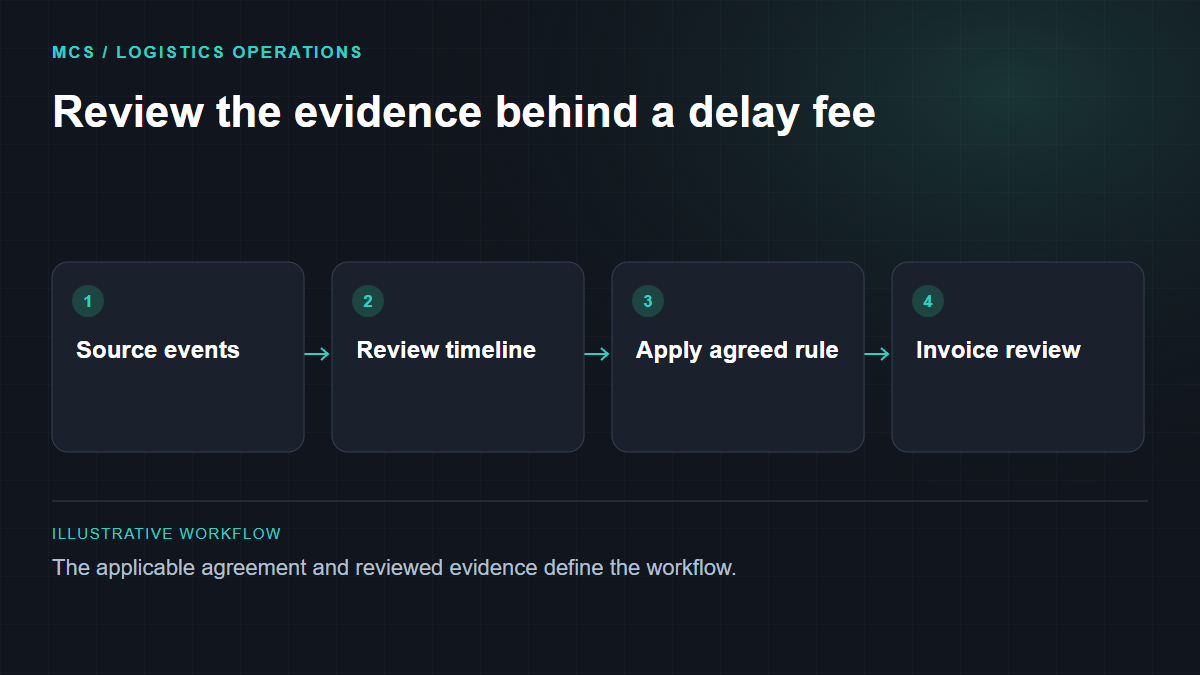
A long stop does not explain itself. Before finance can support a delay charge, your team needs the agreed rule, a reliable event timeline and a clear account of why the delay occurred. Connecting those records makes the calculation easier to review and the next action easier to assign.
Define the qualifying delay
Document what starts and ends a billable waiting period. Clarify the location, responsible party, service type, exclusions and required notice. Waiting at a retailer, waiting for access at a residence and a crew’s internal operational delay may be treated differently.
Record the applicable agreement and rule version. Do not apply a generic grace period or block size to every retailer because it appears in an example or an existing spreadsheet. Any numerical example used during testing should be clearly separated from the actual billing terms.
Identify the evidence sources and their limits
A TMS can record operational status changes. GPS can help show where a device or vehicle was recorded at a given time. Neither source should be treated as a complete explanation of the event. A vehicle near a stop does not, by itself, prove why work could not proceed.
Agree which event source takes priority, how timestamps are normalized and what discrepancies require review. Preserve the original records alongside any reviewed calculation so the reasoning remains traceable.
Design a calculation that can be explained
The workflow should identify the relevant interval, apply any contractual exclusion or grace period, then follow the agreed rate and rounding method. Keep the underlying interval separate from the chargeable quantity. That lets a reviewer see how one became the other.
Make rate changes, overrides and recalculations visible. Where the evidence is incomplete or the rule is ambiguous, hold the record for review instead of creating a confident-looking charge from uncertain inputs.
Connect the calculation to the invoice
A useful invoice reference links the order, stop, service event, rule version and evidence considered. Provide the detail required by the trading partner’s submission process, while keeping customer-sensitive records within the agreed access controls.
Submission is one stage of the process. Track rejections, supporting-document requests, deductions and the eventual payment outcome. Repeated disputes can reveal unclear source rules or event definitions that should be fixed upstream.
Review whether the workflow is improving the operation
Measure records held for missing evidence, calculation overrides, invoice corrections and unresolved variance age. Distinguish an invoice sent from a charge approved or paid. A larger invoiced total is not, on its own, proof that the workflow is more accurate or commercially effective.
Review the results with operations and finance together. If a recurring delay is avoidable, the best improvement may be an earlier notification, a clearer access requirement or a scheduling change—not simply a more automated charge.
Review a stop with conflicting timestamps
Illustrative workflow: GPS shows a vehicle near a delivery location before the crew marks arrival in the TMS. The review compares the source records, the reason for waiting and the event definitions in the applicable billing rule.
The reviewer records the interval used, any relevant exclusion and the basis for the decision. If the available evidence does not resolve the discrepancy, the record remains in review. The workflow makes the question visible before an uncertain calculation reaches the invoice.
What to measure
Track records awaiting evidence, calculation overrides, repeated delay reasons and unresolved invoice differences. Review operational causes with dispatch as well as finance; some recurring waits may need a scheduling or communication improvement.
Before automating a delay charge
- Confirm the qualifying event and current billing terms.
- Document start/end evidence and time-zone handling.
- Agree discrepancy and override review ownership.
- Retain a traceable rule-to-invoice reference.
- Track the payment outcome separately from the invoice amount.
Common questions
Is GPS evidence enough to bill a delay?
It can support the event history, but the applicable agreement and other operational records determine what must be demonstrated. A location point alone does not explain the cause of waiting.
Should we use a standard grace period for every retailer?
No. The relevant agreement determines whether a grace period applies and how chargeable time is calculated. Confirm the rule for each scope before implementation.
Plan your next step
Bring an anonymized stop timeline, the applicable rule and one disputed calculation. MCS can help map the evidence and review process your team needs.