
Your crew can complete a delivery while your office is still chasing the instructions, proof and service details needed to close it. For white-glove and big-and-bulky carriers, a better workflow starts by connecting the retailer's promise to the crew's work and the billing record.
Start with a common order record
Define the identifiers that connect a retailer order, its physical items, delivery tasks and service charges. Keep item quantities and serial numbers separate from services such as assembly or haul-away. Validate addresses, contact details and service requirements before the order reaches dispatch. A missing field should create an actionable exception with an owner, not disappear into an inbox.
For Canadian and US operations, account for postal and ZIP code formats, local time zones and the agreed units used for distance or service areas. Those details belong in the mapping and acceptance tests, not in a dispatcher’s memory.
Make the crew procedure match the promised service
Document the service steps your crews are actually authorized and trained to perform. A useful procedure covers arrival checks, access constraints, handling precautions, the work performed and the evidence required to close the job. Installation tasks need the appropriate qualifications and retailer instructions; a generic checklist should not imply that every crew can perform every installation.
Connect exception codes to a next action. A refused item, access problem or missing part should tell dispatch and customer service what happened, what information is available and who can decide the next step.
Send updates from supported operational events
Choose the events that can reliably drive customer and retailer updates. An order received, a delivery window assigned and a completed stop are different facts. Define the source of each event, the message it can trigger and how corrections are handled. Do not present an estimated arrival as a guaranteed time.
Customer service should be able to see the same event history and supporting records. That makes an update useful when a delivery changes, rather than simply generating another notification.
Make billing a continuation of the delivery record
Before an order becomes an invoice, check the evidence required by the applicable retailer agreement. The billing workflow should connect service codes, delivery outcomes, approved accessorials and relevant timestamps to the correct rate version. Ambiguous records belong in a review queue.
Keep invoice submission separate from payment reconciliation. A submitted invoice is not a paid invoice, and an accepted delivery event is not automatic approval of every charge. Track the status of each handoff.
Pilot one complete workflow before expanding
Choose a retailer and location with representative orders and available operational users. Test a successful delivery alongside a reschedule, a failed stop, a return and a billing exception. The pilot is complete when the team can explain what each system received and how the exceptions were resolved—not after an arbitrary number of days.
Record the initial volume of manual touches, incomplete proof records, status exceptions and invoice corrections. Use consistent definitions when comparing the pilot with later operations. Improvements should be demonstrated with your own records rather than assumed from a software feature list.
Follow a sofa delivery through to invoice review
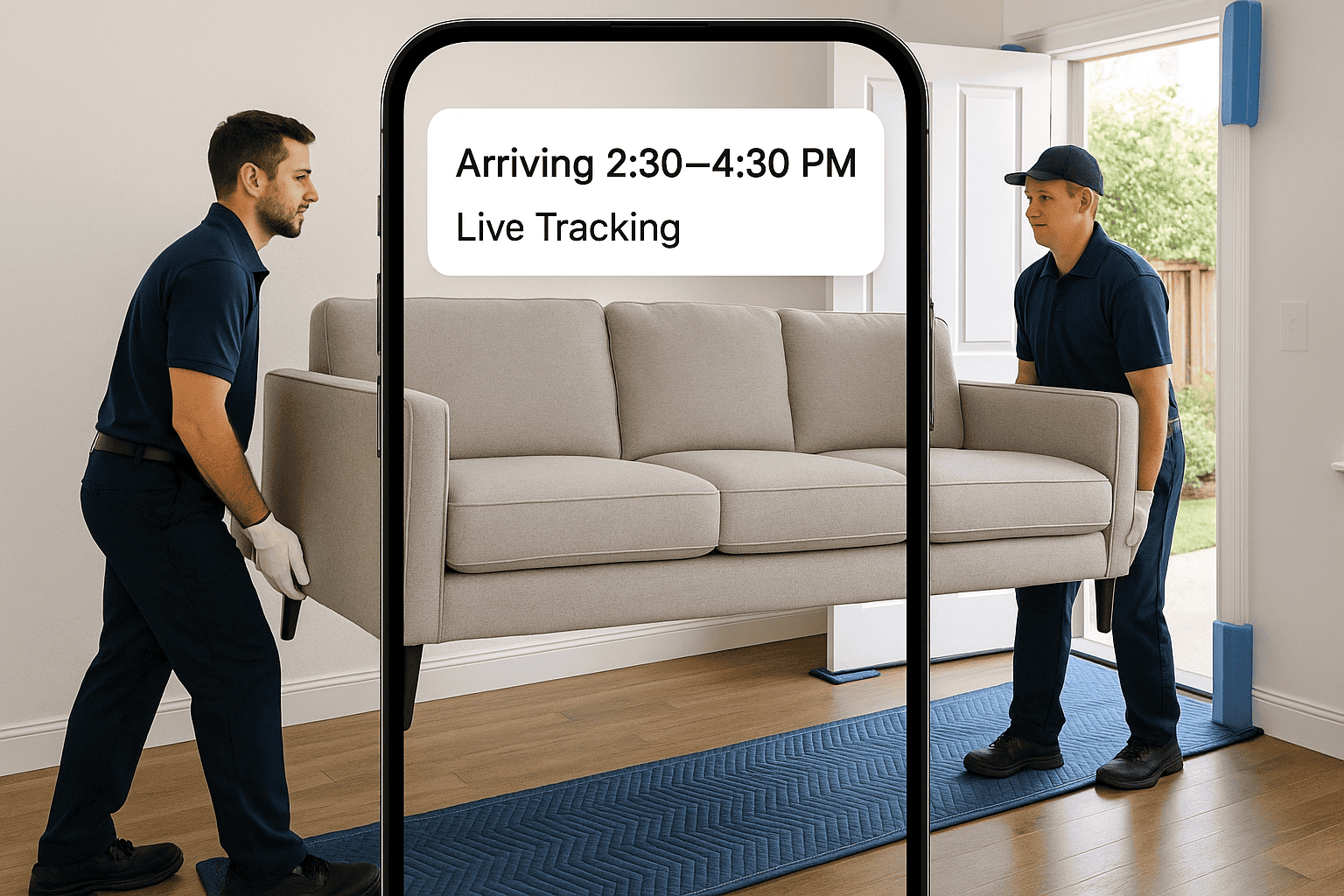
Illustrative workflow: a retailer sends a sofa order that includes room-of-choice delivery and packaging removal. Order intake keeps the item line separate from the service instructions. Dispatch and the crew receive the agreed scope, and the completion record identifies the services actually performed.
If access prevents completion, the crew records the relevant exception. Customer service sees the same event, while finance reviews the delivery evidence against the applicable agreement before billing. Each team can follow the same order without treating an attempted stop as a completed service.
What to measure
Track incomplete service instructions, missing delivery evidence, repeat data entry and invoice corrections. Use the same definitions across the comparison period so an apparent improvement is not simply a change in classification.
A practical readiness checklist
- One shared order reference across the retailer, TMS and billing workflow.
- Item identifiers separated from service lines.
- Crew procedures aligned with the contracted service scope.
- Named owners for delivery, data and billing exceptions.
- Representative end-to-end tests and agreed success measures.
Common questions
Do we need a new TMS to improve white-glove delivery?
Not necessarily. Start by reviewing your existing interfaces, data quality and workflow ownership. Integration may address the gap without replacing the system your dispatch team uses.
Which metric should we improve first?
Choose the measure closest to the bottleneck: incomplete order records, missing proof, repeated customer enquiries or invoice corrections. Establish a baseline and a consistent definition before setting a target.
Plan your next step
Choose one retailer and one delivery type. Bring the order instructions, crew closeout record and billing handoff to MCS so we can discuss a practical first scope.